Great writing bends the rules and grammar has a lot of rules to bend.
After finishing Bob Shacochis’ The Woman Who Lost Her Soul, I read some online reviews at Goodreads and in blogs, both personal and professional. I was surprised by the comments made by very intelligent and persuasive writers and critics. Many of them were dogmatic about the need for punctuation, as if their mental faculties could not reach beyond the omission of quotation marks and commas. Some remarks were scathing enough to suggest that the author needed “A real editor,” because the “syntax felt disjointed at times,” and “missing commas and containing long, descriptive sentences.” Regardless of these critics, this book was nominated for a Pulitzer. Yet, Cormac McCarthy’s No Country for Old Men did not receive the same demerits from its audience (and was never nominated for a prize, gaining wide-spread notoriety only through film). Sure, there were many who sarcastically mimicked his southwestern dialog, but did little to comment on his use of syntax and punctuation, which resemble in many ways those of Shacochis. I wonder if these people felt the same way after reading Their Eyes Were Watching God by Zora Neale Hurston.
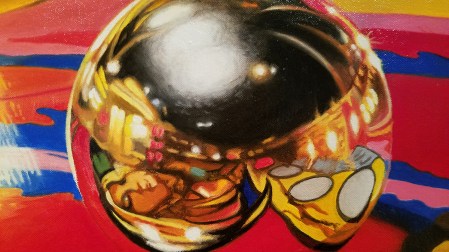 Several arguments can spring from this interesting problem, such as the Goodreads community and the credibility in their comments. Also, the popularity of a writer seems to lessen the barrage of criticism. What really is at stake here are the stylistic concerns for two incredibly talented writers of our time. The artists chose to omit much of the typical punctuation, handling punctuation as a painter deals with color selections and placement, in order to convey two very different stories.
Our eyes rise and fall on the written page, following the channel markers provided by commas and quotation marks. These are some of the most common marks in a book. Of course, the period plays a major part, as does a hyphen and the dreaded semicolon; however, between the first letter of a sentence and the period, commas are frequent, as well as quotation marks.
Both Shacochis and McCarthy forgo the open and closed quotation marks in all of their dialog. Yes, this can be confusing at first, like adjusting your eyes in after the light has been turned on in a dark room. The blending of narration and dialog made my thoughts jump around, never stalling, trying to figure out the speakers. If it frustrates you, then you can skim beyond and hopefully retain some of the meaning of what was said. Or, you can go back and learn the voice of the speaking character and know who is talking without the use of quotation marks. Sure, it takes a bit of work, but so does looking at an amazing painting (there are so many, just think of one), in order to analyze the depth of intention each brush stroke presents. Shacochis’ characters’ voices present themselves brilliantly, with singularity, from a master of the craft. Eventually, I noticed that the omission of quotation marks sped up my progress through the novel, which is a very nice thing considering Shacochis’ work exceeds 750 pages, travels two continents, and has all the trappings of an international spy thriller.
McCarthy’s work is more terse, masculine, and brief, reflecting the simplicity and emptiness of the landscape. Whether it’s third person or first person narration, the character’s voice is clearly heard and understood. The reader understands the frustration of Sherriff Ed Tom. Moreover, the reader feels the tension of what is not said. Hitchcockian tension from the omitted. Following Chigurh’s almost quixotic, definitely crazy, dialog, the rapidity of exchanges heightens the need to slow down and read them closely. Moments that take place, such as the coin toss to decide a potential victims fate exemplify the cold, dark reality of irrational violence, a violence without empathy, the sociopath on display.
Stan ding firm with grammarians is important, and many omitted marks can confuse a reader. But, think of these artists like they are Pizzaro or Monet, trailblazers into new dimensions of writing theory, like the impressionists, who “Impressionism was a style of representational art that did not necessarily rely on realistic depictions. Scientific thought at the time was beginning to recognize that what the eye perceived and what the brain understood were two different things.”* These books are a form of impressionism. They provoke a sense of feeling. Are Chigurh or Jackie Scott real? Possible, even probable, but not real. They are representational of evil, chaos, fate, and the unknown. All are powers beyond anyone’s reckoning, yet we strive to try and control them as best we can.
If you’ve already taken up the banner of contemporary techniques in fiction, then this essay has very little to do for you, other than possibly introducing something partially enlightening. But this essay is more for those who would believe that sentences need to be tight, always, and precise, forgetting the nuance of a narrator’s voice, their cadence toward highlights in a story, sometimes building the journey that leads to their feeling excitement or dismay. It’s all there for the reader to feel. And, yes, omission of punctuation does this.
 Michael Leo Premo
There exist more written words in this world than I could read in a lifetime of lifetimes. If an author doesn’t make it easy for me to read his work, I simply don’t bother trying and move on to the next author instead. YMMV.
LikeLike